Water scarcity is a major threat for life on Earth. The small fraction of water that is available for human consumption (2.5% of the total), in rivers and streams, lakes, reservoirs, and groundwater aquifers, is not distributed uniformly around the world. Demographic growth, economic development, and improvement of living standards, climate change and pollution are major causes of increased water consumption and also of water quality deterioration.
It is impressive that the total annual water withdrawal was less than 600 km³/year, at the beginning of the twentieth century and was more than 3 800 km³/year at the end of the same century. Although water use is inherently circular, natural and man-made systems to depurate water are no longer capable of producing clean waters, exempt of environmental impacts.
Nevertheless, the accelerated water circularity is no longer an option; it is a necessity in many regions of the world and will soon be a requirement for many others. It is increasingly recognized that water circularity is an unavoidable circumstance that can affect human and environmental health. However, it can be also a driver to improve wastewater and water treatment and to protect one of the most precious natural resources, whose exhaustion is becoming evident.
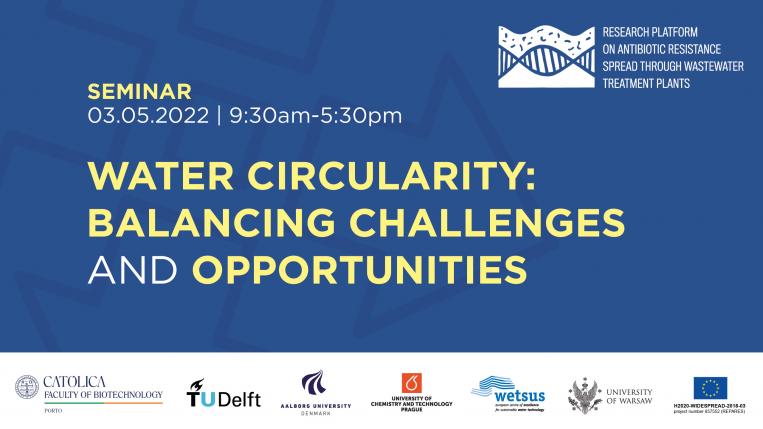
However, water circularity brings also new challenges. The widespread and increasing occurrence of contaminants of emerging concern (pesticides, biocides, pharmaceutical, and industrial chemicals), where antibiotic resistant bacteria and antibiotic resistance genes can be included, represent major obstacles to attaining wastewater with water quality standards capable of avoiding the food web contamination. This is essential for the promotion of One-Health, where water is a major connecting link, uniting humans, animals, and the environment. This seminar aims at discussing that despite the threats that water scarcity may bring, water reuse can be a truly win-win approach, influenced by both the incentive to improve wastewater treatment and to reuse what has been discarded.
Keywords: Water reuse; Antibiotic Resistance; Public Health; One-health
Program:
WET |
Topic | Delegates |
| 3rd May 2022 | ||
| 9:30 | Opening session Presentation of the H2020 project “RESEARCH PLATFORM ON ANTIBIOTIC RESISTANCE SPREAD THROUGH WASTEWATER TREATMENT PLANTS (REPARES)” |
Jan Bartáček (UCT) and Célia Manaia (ESB-UCP) |
| 10:00 | Analysis, Treatment, and Effects of Contaminants of Emerging Concern in Wastewater and Receiving Surface Water | Diana Aga (UB) |
| 10:45 | 20 years of indirect potable water reuse in Flanders, Belgium | Emmanuel-van-Houtte (IWVA) |
| 11h30 | Coffee break | |
| 12:00 | Adsorption- and membrane- based processes for advanced urban wastewater treatment for water reuse | Maria João Rosa (LNEC) |
| 12:45 | Lunch | |
| 14:30 | Antibiotic Resistant Bacteria and Genes (ARB&ARGs) in the Urban Water Cycle: Evidences and Challenges | Ivone Vaz-Moreira (ESB-UCP) and Olga Nunes (FEUP) |
| 15:15 | ResistApp, an innovative combination of digital platform and SmartChip qPCR for antibiotic resistance monitoring in wastewater | Windi Muziasari (Resistomap) |
| 15:45 | Coffee break | |
| 16:00 | Round Table New Trends in Water Circularity and Quality – new solutions for emerging problems |
Maria João Rosa (LNEC) Sérgio Silva (Adventech) Luís Marinheiro (AST/WEDOTECH) Norberta Coelho (Águas do Norte) Moderators: Jaqueline Rocha and David Calderón |
| 17:15 | Wrap up Closing session |
Célia Manaia (ESB-UCP) |