
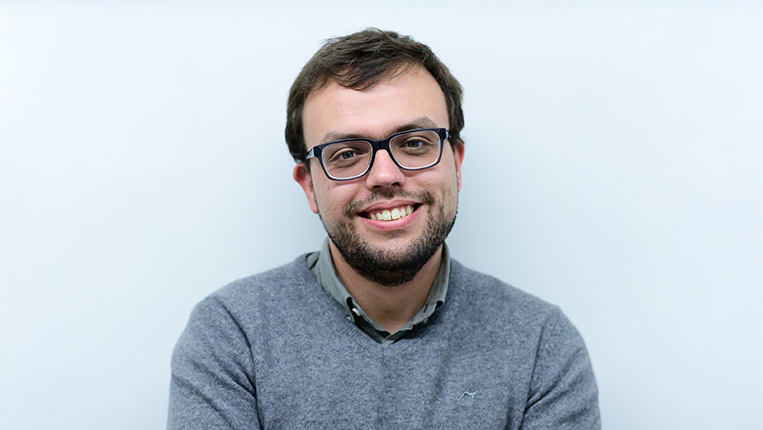
Pedro Miguel Rodrigues is a lecturer and researcher, co-coordinator of the Bioengineering undergraduate degree in the Biomedical Engineering area, and a member of the Board of the Faculty of Biotechnology. Dividing his time between research and teaching, he focuses mainly on the early diagnosis of neurodegenerative diseases. What drives him? “The real impact we can have on people’s lives.” In this interview, he reflects on the challenges of artificial intelligence, the importance of fostering scientific entrepreneurship, and the value of close, personalised teaching - a distinctive mark of the Faculty of Biotechnology.
You were born in Seia, in Serra da Estrela. What memories do you have of your childhood?
I was born in an inland region, that is sometimes forgotten… Perhaps because of that I had the chance - unlike children in big cities - to play outside until very late, running around with friends until my parents came to “grab me by the ear” to take me home. Those were very happy times. I was very happy. I wouldn’t trade it for anything.
Which subjects excited you at school?
I always liked mathematics - it is the foundation of engineering. The logic behind things and numbers has always fascinated me. Today, I work with programming applied to the development of technologies for health and also in the food sector. I would have liked to become a mathematics teacher, although that never happened for several reasons. When I arrived at university, I realised that engineering applied to health made sense for me, because I also enjoy creating solutions for people.
When you graduated in Biomedical Engineering, it was still a relatively unknown field…
It was a challenge! At the time, Biomedical Engineering was not very visible; it didn’t have much recognition nationally or internationally. We were part of the first cohorts to graduate from that programme. A new degree always faces more difficulties in establishing itself in the market, but on the other hand this also opens new doors.
The degree met my expectations and even exceeded them. The training I received gave me the foundations I needed to work in several areas today. And that’s what we want in a degree programme: that it prepares us to be entrepreneurs and to create new tools, whether inside or outside our specialised field. After finishing my undergraduate degree, I went on to a master’s, where I specialised in intelligent data processing and technological solution development.
When did you decide to pursue an academic career?
I spent around a year in Valladolid, Spain. The daily work with those researchers was extremely rewarding and allowed me to grow enormously.
That experience made me realise that I wanted to train students for the job market, share my knowledge with them, and help them grow, just as others had done for me. My master’s thesis supervisor was very proactive and gave me countless opportunities. I travelled to China with him; he showed me a bit of the world. The possibility of spreading knowledge and sharing it with others was important for my growth. And so, I went on to do a PhD!
My motivation is to teach students that the world does not end in the laboratory, because there is a whole world outside, and we must share what we know. Only then can there be growth - personal and scientific - in a community that is increasingly dynamic and competitive.
“What fascinates me in Biomedical Engineering is the real impact we can have on people’s lives.”
What fascinates you about Biomedical Engineering?
What fascinates me is the real impact we can have on people’s lives. During my PhD, I met patients in the early stages of Alzheimer’s who, in two or three years, were already in very advanced stages and unable to perform simple daily tasks. Witnessing cognitive and motor decline is deeply striking. If I can do something to minimise this decline, I feel it is my mission.
I work extensively in diagnostic and in solutions that allow the detection of diseases at very early stages, making it possible to apply drugs that reduce suffering and symptoms. I currently lead a research team developing diagnostic support solutions for Alzheimer’s, as well as other neurodegenerative diseases. Almost all of us know someone with a neurological condition. Students who work with me - in master’s projects, final-year dissertations, or PhDs - also come across these cases, and they are deeply affected by them. Working in this field allows us to leave a positive and meaningful contribution. And that is exactly what students seek: to do something relevant and leave their mark.
“Unlike artificial intelligence, which recreates, we try to encourage students to create.”
What distinguishes the teaching approach at the Faculty of Biotechnology?
We offer a practical, hands-on education, very focused on “doing”, unlike a purely theoretical approach. Here at the Faculty of Biotechnology we encourage students through experiences that make them think and, above all, create new things. Unlike artificial intelligence, which recreates, we try to encourage students to create. This helps prepare them for the job market. Out there, we need to be increasingly better, and only by analysing practical case studies and understanding real-world problems can students truly grasp concepts that are often abstract. It is essential to train students who are creative, proactive, and critical thinkers.
You were studying artificial intelligence long before it became a buzzword…
Since my undergraduate studies! My final project was already on the application of artificial neural networks, at a time when we would spend hours in front of the computer waiting for results. It was even thrilling when a number appeared on the screen, we thought, “It learned!”. The system had learned. Back then - and this was almost 20 years ago - computing power was very limited. You had to be resilient and wait a long time for results. Today, the same tasks take only seconds. The evolution has been incredible.
How do you navigate the challenges of generative artificial intelligence?
I work with AI daily in the laboratory. It is predictive AI, which needs to be programmed and trained, and therefore very different from generative AI, which produces new data. I’m sceptical about the current form of generative AI succeeding. The issue is that today’s AI feeds on everything and may give subjective or inconsistent answers.
I believe in a Generative AI 2.0 - more directed, specialised, and trained on datasets curated by experts. Only then can we rely on what AI tells us.
AI should be used as a tool, just like the calculator simplified our lives for doing maths. It should be used critically: it helps, but we are the ones who decide, create, execute - or instruct the execution of - a solution. I encourage students to use AI to speed up processes, but always taking responsibility for what they produce.
“An idea shouldn’t stay in the lab - it needs to reach society so we can evolve.”
How do you challenge your students?
I try to instil an entrepreneurial mindset: to create their own business, bring ideas to the market. An idea shouldn’t stay in the laboratory; it needs to reach society -directly or indirectly - for us to evolve. Brilliant results that never leave the lab are lost knowledge. That’s why I encourage students to let ideas flourish and make them accessible.
And what do you learn from your students?
I learn a great deal from them, often in challenging situations. Students bring new perspectives and sometimes simpler solutions that we hadn’t considered. They help us “come back down to Earth” and focus on what truly matters.
Pessoas em Destaque é uma rubrica de entrevistas da Universidade Católica Portuguesa, Centro Regional do Porto.